
Much as it pains me to say, this week I find myself in tax dodging Starbucks, in its Epping incarnation, famed for its 'Swiss' coffee and creative accountancy. My excuse is that I needed a decent internet connection and also a little space away from friends, many of whom view the idea of contributing to Starbucks' coffers with some distaste.
After another week in the UK, I realise that my definition of a pleasant day seems to have changed quite drastically over the past couple of years. Gone are the days of finding 18 or 19 degrees centigrade comfortable; after spending weeks, or even months, in the mid thirties, such days now seem positively chilly. Odd too how one notices all the little aches and pains that a body is heir too in such weather as is prevalent here in the UK. In Southern China and, particularly, in Thailand, such things scarce came to my attention. Perhaps the last few years have rather spoilt me in this way, now the prospect of spending months of one's year in such a climate as here in the UK seems positively unpleasant.
One of the most positive aspects of my recent travels has been just how healthy, how energetic, I had been feeling. I am, hopefully, not quite over the hill yet, but certainly could be described as a tad long in the tooth. Yet during the past five months it has been noticeable just how well, how energetic, how downright healthy I have felt.
For much of this time I have become increasingly interested in Chinese health systems that relate to the idea of chi. For those who have never heard of such a notion, chi is defined as a universal energy that exists in all living things. To feel well, according to this paradigm, one has to find ways of increasing one's chi, or at least to having access to good quality chi. The latter, in the Chinese system, is considered a matter of clearing the body of stagnant and stale chi, and replacing it with fresh and flowing chi. The techniques evolved by the Chinese Taoists were originally known as qigong. As ever with Chinese, the sound of the words is a lot more exotic than its literal translation of 'energy work'.
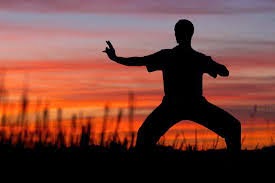
Over the last few years, such esoteric health systems seem to have played a significant role in my life. At times, it almost feels as if these ideas have found me, rather than me them. My first exposure to the concept came about seven or eight years ago now. At the time I was severely incapacitated due to nerve damage from a previous climbing accident, the effects of which had dogged me for most of my adult life.
One day, whilst wandering along a local High Road, supported by a pair of walking sticks, I happened to notice an advert for acupuncture in the window of a shop that specialised in all things Chinese, and particularly Traditional Medicine. I tended to notice a lot of such things in those days. One of the benefits of finding one's normal walking pace to be as painfully slow as mine was at the time, is that one finds one has time to notice an awful lot more detail than was previously the case when I would blithely yet somewhat blindly wander the streets in good health. In my youth, I had often rushed around at a helter skelter rate as is the rather over-urgent norm of our present day society.
On enquiring how much such treatment would set me back, I was informed it would require a rather chunky £360 for 12 sessions. At other times, I might have been reluctant to spend such sums on what seemed to me to be a somewhat fanciful form of treatment, but as being confined to using a pair of walking sticks just to get about tends to restrict the things one wishes to spend money on, it seemed a reasonable idea to at least give acupuncture a chance.

I think my interest was also piqued as the year before I had spent much time in researching a book about the idea of a vital life force, and how this same idea seems to crop up again and again, being found in different guises in many cultures and spiritual systems around the World. I had managed to complete several chapters of the book covering such interesting notions as prana in yoga, huna in the Hawaiian spiritual system, odic force as explicated by Von Reichenbach in the 19th century, Henri Bergson's Elan Vital and even Wilhelm Reich's intensely sexual idea of a universal orgone energy.
Researching and writing about such things had been a pleasurable experience as I found many similarities in these various systems, and was fast confirming the idea that they were all essentially talking about the same thing, albeit using vastly different terminologies. All was going well with the book until I reached the chapter that was to deal with the Chinese Taoist idea of chi. Although it was clear that the concept was, in many ways at least, quite similar to the other examples, it seemed that the more I looked into it, the more complex and the more subtle the ideas became. In the end, it struck me as unfair that I should mislead any potential readers of the book by pretending I had sufficient knowledge of the concept of chi to warrant giving my opinions on the subject.
My first practical exposure to these ideas came with that first course of acupuncture. Many of a more scientific bent tend to want to decry the effects of this system and, it has to be admitted, there are many aspects that don't easily fit into Western ideas as to how the body works. Some of the critics tend to observe that any positive effects are probably down to placebo effects alone. My own expectations had been initially very low, but I did think that, given my parlous state at the time, it was worth trying at least.
Despite my low expectations, within a few weeks I was able to do away with one of the sticks. Within another month, I was walking unaided for the first time in quite a while. Whether I understood what was occurring or not, clearing something had changed. At the end of the treatment, I found myself walking relatively normally again and, quite pleasantly, out of real pain for the first time in years. There was a leftover numbness that stretched down the side of my right leg and into the foot, making moving the toes of that foot more or less impossible, but it seemed a small price to pay, generally preferring pleasantly numb to positively painful.
Such experiences made me quite open to the suggestion that I should indulge in a little qigong whilst I was in China. Again my expectations were relatively low, but even after a short while my flexibility began to improve. Also, my general sense of well-being, of joie-de-vivre even, had clearly taken a turn for the better.

After about three weeks I began to notice that feeling was returning to my toes and, lo and behold, for the first time in years I was actually beginning to move them again. At first the movements were slow, barely perceptible in fact. I even dismissed them originally as mere wish fulfilment. Over time though, little by little, strength began to return, and with that strength came an ability to balance on that foot once again.
My understanding of nerve damage had led me to believe that such results were nigh on impossible, but on the other hand, it is hard to deny one's own personal experiences even if they don't fit the paradigms one it given by Western medicine. In the couple of months since, the numbness has continued to subside but the old pain has not returned and, as an added bonus, the strength seems to be gradually returning to muscles that had been dormant for many a year.
Looking back on my time in China from a distance of some weeks, I have come to realise that much of what I valued and enjoyed in China were the remnants of the past, the gifts of a long and fascinating history. The philosophy, the spiritual systems, even the architecture of previous dynastys has left China with a deep and rich source of inspiration and guidance which, unfortunately, much of modern China seems to be busily ignoring in its headlong rush towards a supposed modernity, which expresses itself by way of aping the worst excesses of Western decadence and capitalism.
As I sit here, slightly shamefacedly enjoying the delights of a fairtrade coffee in Starbucks in Epping, I find myself once more yearning to go back and enjoy the best of what China has to offer, even if that emotion is mixed with a dread of the worst. Yangshuo, with its clear waters, beautiful peaks, wonderful vistas and clean air beckons just as much as the East Coast cities with their constant noise, teeming crowds and choking pollution repel.
China is forever an enigma, its history and culture being both fascinatingly deep and subtle whilst simultaneously its modern developments are ugly and depersonalising almost beyond believe. I find myself both loving and loathing the place in almost equal measure...

